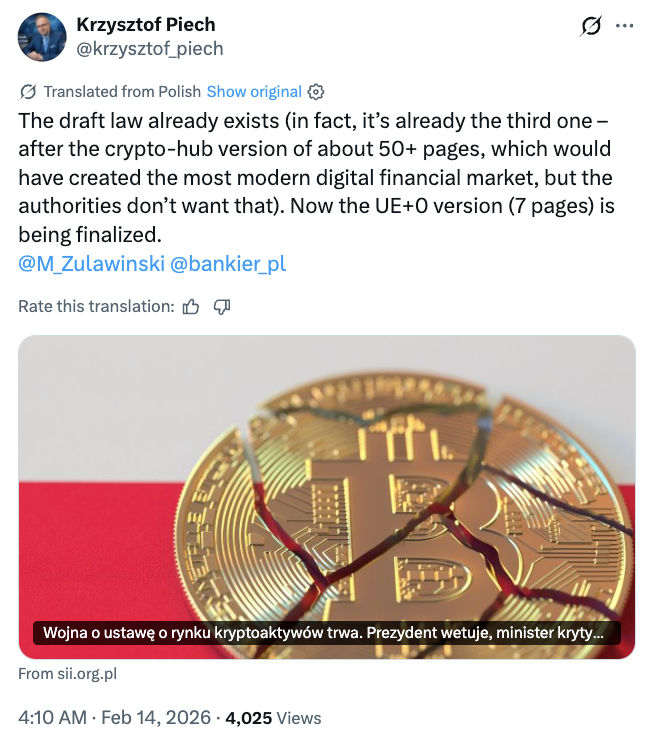
Poland‘s Ongoing Crypto Regulation Drama: A Second Veto
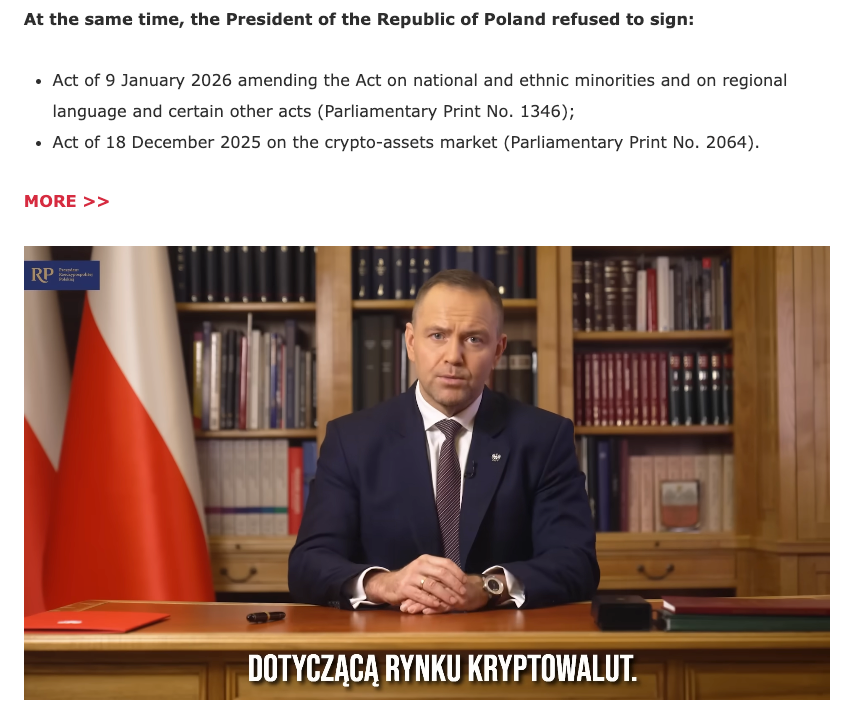
The Polish crypto landscape is once again grappling with uncertainty. President Karol Nawrocki’s recent veto of a second bill designed to align the country’s regulations with the European Union‘s Markets in Crypto-Assets (MiCA) framework has sent ripples through the local industry. This decision, mirroring a similar veto in December, has left crypto businesses in a precarious position, particularly as the looming July 1, 2026, transition deadline for MiCA implementation draws closer.
The Implications of the Veto
The core issue revolves around the absence of a domestic licensing pathway for crypto companies. Without a local framework mirroring MiCA, Polish businesses are forced to consider alternative strategies to maintain or expand their operations. The Polish Financial Supervision Authority (KNF) has also warned that Poland has yet to designate a competent authority to supervise the crypto market, further complicating matters. This regulatory void creates a challenging environment for local players.
The Regulatory Imbalance: A Tale of Two Worlds
One of the most significant consequences of the veto is the creation of a regulatory imbalance. Companies seeking a MiCA license in other EU countries, such as Luxembourg, can potentially operate in Poland via passporting, while Polish companies are currently left without a clear domestic licensing process. This disparity could incentivize a migration of Polish crypto businesses to more favorable jurisdictions.
Industry Reactions and Alternative Strategies
The situation has prompted various reactions from industry players. Some, like Kanga Exchange, had anticipated this outcome and prepared for alternative licensing options outside of Poland. Sławek Zawadzki, co-CEO of Kanga Exchange, noted that the company had proactively considered that the MiCA-implementing law might not be enacted in time. Other firms, such as Zonda Crypto, which was originally established in Poland but now operates from Estonia, have already pursued licensing outside of Poland, intending to passport those licenses back into the country. Przemysław Kral, CEO of Zonda Crypto, anticipates that the regulatory uncertainty could push smaller local crypto companies out of the market.
The Search for a Solution
Amidst the uncertainty, some hope remains. Polish economist Krzysztof Piech is reportedly working on a new, more crypto-friendly proposal to implement MiCA in Poland. This demonstrates a clear division within the government, and the president, on how to approach digital assets. Nawrocki’s actions suggest a more industry-friendly stance. The president stated that he will not sign a law that is “wrong.”
Key Takeaways
- The second veto creates regulatory uncertainty for Polish crypto companies.
- A regulatory imbalance emerges, favoring foreign licensed entities.
- Some companies are seeking licenses in other EU jurisdictions.
- Smaller businesses may be pushed out of the market.
- A new MiCA-friendly proposal is in development.
“Poland should attract innovation, not push it away.” – Polish President Karol Nawrocki
As the July 2026 deadline looms, the Polish crypto market awaits clarity. The developments necessitate strategic adaptation and potentially a shift in the landscape, reshaping the futures of those businesses that must meet the deadlines.
The ultimate resolution remains uncertain, but the pressure to find a workable solution is mounting as the deadline approaches.